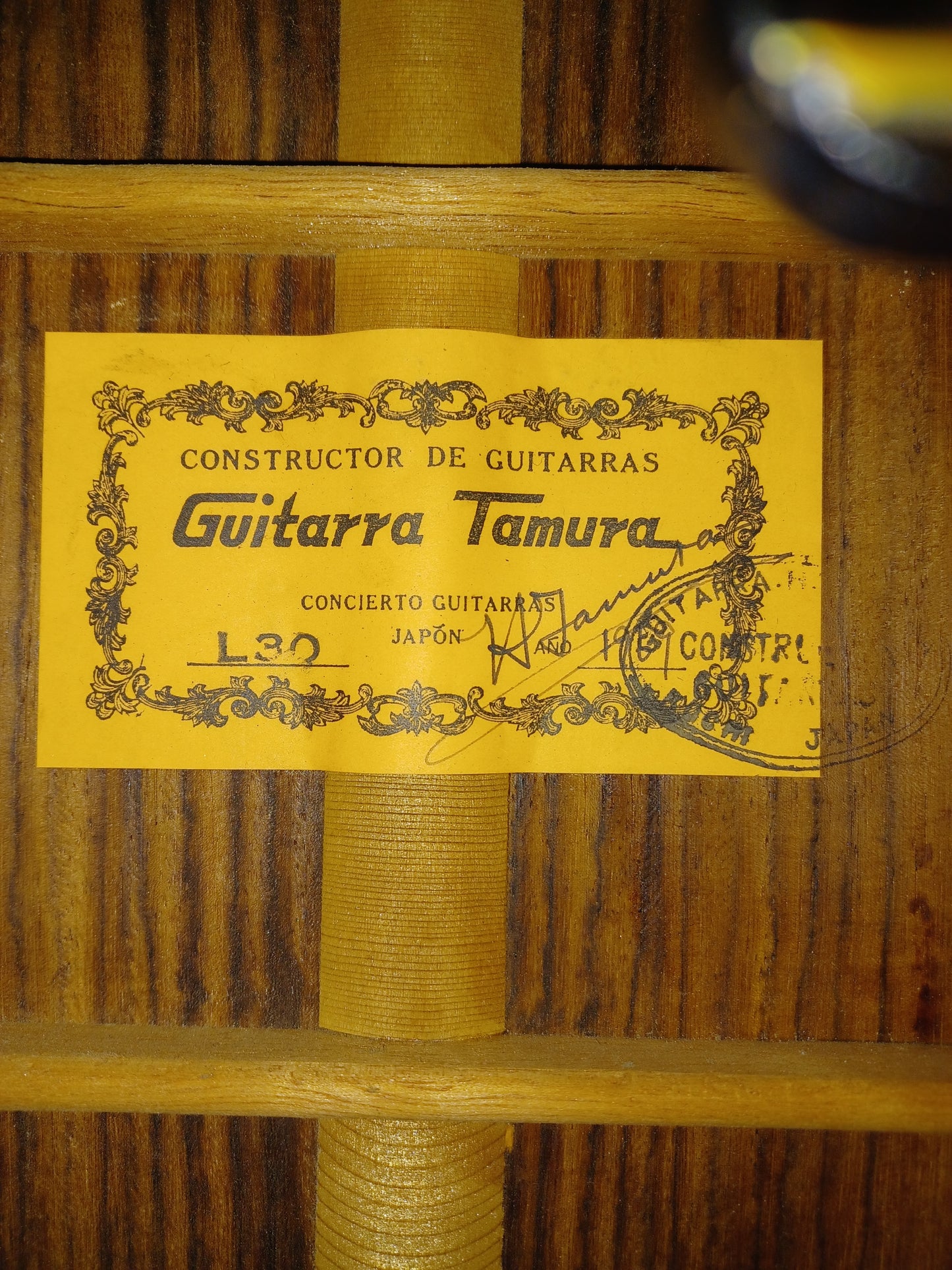
Hiroshi Tamura L30 Handmade Alto (Terz) Classical Guitar 1969
Hiroshi Tamura L30 Handmade Alto (Terz) Classical Guitar 1969
Hiroshi Tamura L30 Handmade Solid Wood Classical Alto Guitar
A one of a kind instrument with beautiful, bright tone, great sustain and excellent playability. This model is extremely rare, I have never seen any other available.
The six-string alto guitar or G Guitar or Terz guitar is a smaller version of the classical guitar, designed to be fitted with lighter strings and tuned a perfect fifth higher, to B-E-A-D-F♯/G♭-B.
Terz guitar (Terz meaning third) refers to either a small sized classical guitar or to the practice of tuning a standard guitar a minor third higher than standard guitar tuning (as though a capo were on the third fret of the guitar). The scale length is generally 530 mm (20.8 inches), though sometimes as long as 560 mm (22 inches). Mauro Giuliani and Caspar Joseph Mertz wrote extensively for the terz guitar as a complement to the prime (standard) guitar.
Specs
Top: High grade Solid Cedar
Finish: Cashew Lacquer
Back and Sides : Indian Rosewood
Neck: Mahogany
Fretboard: Ebony
Scale Length: 548 mm
Nut Width: 50.3 mm
Action at 12 fret (1st): 2.75 mm
Action at 12 fret (6th): 3.25 mm
Original Hard Case included
The guitar is tuned to B-E-A-D-F♯/G♭-B, a perfect fifth higher than the standard tuning. Set up with D'Addario EJ-52 Alto guitar strings
Despite its age, this guitar is still in very good condition. While it does show some minor signs of wear and tear in the form of a few dings and scratches on its body, these are not significant enough to be a cause for concern. In terms of its structural and functional integrity, this guitar has held up incredibly well over the course of its 50-year lifespan. It is set up for medium low action and easy to play. There is lots of life in the frets and enough room on the saddle for action adjustments.
Hiroshi Tamura was one of the top luthiers in Japan.
Him and his brother Mitsuru Tamura, like many other renowned Japanese luthiers of their time, learned their craft during their stay in Spain in the late 1950s to early 1970s. After returning from Spain, the Tamura brothers began crafting high-quality flamenco guitars that rivaled those made by the most famous Spanish luthiers. Their flamenco guitars gained them international recognition and were played by numerous professional players. Although they are now difficult to find, their earliest flamenco guitars date back to 1962.
It is believed that during the 1960s, the brothers shared a workshop in Kochi, Japan. While both brothers possessed equal skill, Hiroshi garnered more international and domestic accolades. His guitars were often deemed superior to those made by Jose Ramirez, and as a result, Hiroshi earned the nickname "Tamirez." In fact, Hiroshi's awards outnumbered those collected by Masaru Kohno.
In 1972, Hiroshi received financial recognition from the Japanese Ministry of Technology. Shortly thereafter, he moved to a new shop not far from his brother's and hired several associates. There, he began producing his P and C models in greater numbers and successfully exporting them outside of Japan. Only the very top models were made exclusively by Hiroshi himself.
History of Japanese Classical Guitar Making
From the late 1960s to the mid 1980s, Japanese luthiers produced guitars of exceptional quality. These skilled craftsmen typically ran small shops, employing a handful of master builders who were often trained in Spain or under Spanish master builders in Japan. During this period, bans on certain types of wood were not yet in place, allowing luthiers to source high-quality wood for their creations. Although these guitars are considered a bargain in today's market, finding top-quality Japanese classical guitars from this era can be challenging, and restrictions on exporting certain types of wood make them even more difficult to obtain. Similar guitars built with comparable materials today would cost significantly more due to the scarcity or complete bans on certain types of wood. Most of those talented luthiers from the 70s and 80s are now retired or have passed away.
Couldn't load pickup availability
Out of stock
View full details