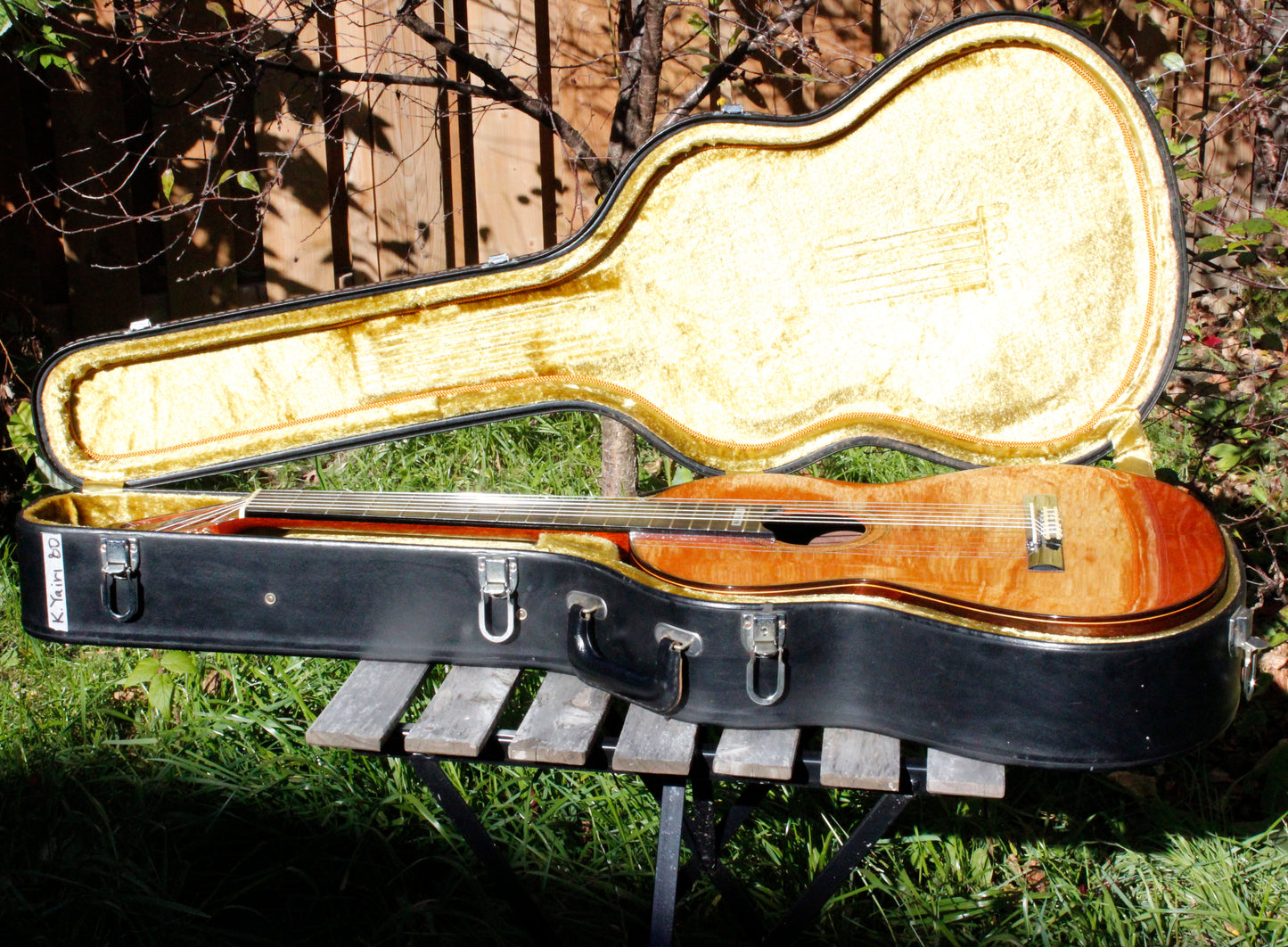
Kazuo Yairi YC80 Handmade Concert Classical Guitar, Brazilian Rosewood Japan 1981
Kazuo Yairi YC80 Handmade Concert Classical Guitar, Brazilian Rosewood Japan 1981
A rare, stunning Ramirez style Concert Guitar handmade by Kazuo Yairi in 1981. A high end model in his lineup. This one is truly one of a kind as it was a tribute to Masaru Kohno - hence the abalone inlay on the fretboard. The label inside the body of the guitar is hand-signed by the luthier.
Unquestionably, Kazuo Yairi remains a standout figure among Japanese luthiers. His classical and steel string acoustic guitars have carved a special place in the hearts of musicians worldwide, endowing them with a lasting and unique allure.
What set Kazuo apart was his unique approach to crafting instruments. His handmade guitars, renowned for their exceptional value, are a testament to his distinctive business philosophy. A remarkable facet of this value stems from the fact that Kazuo has personally nurtured and inspired many young luthiers who have carried on his legacy by creating signature Yairi guitars. These guitars emanate from the Yairi "factory" nestled in Kani, located within the Gifu province of Japan. Over the years, a multitude of guitar models have been produced, with certain models exclusively tailored for overseas markets, remaining undiscovered by the US and European players.
The guitar that you see here was built in 1981, emerging as a coveted high-end gem within the Yairi lineup of that era. This model is just a step below the YC100 and YC150, also notable for their solid figured Brazilian Rosewood backs and sides.
Remarkably, in 1981, this fine instrument bore a price tag of 80,000 yen.
It is absolutely amazing that this high-end Yairi creation was priced with a sense of modesty that was simply unprecedented, especially when you consider the equivalent instruments crafted by esteemed Japanese luthiers such as Masaru Kohno, Sakazo Nakade, and even the Yamaha company. Their pricing for instruments of similar class easily exceeded Yairi's guitars by 1.5 or even 2 times. This intentional approach to affordability not only defined Kazuo's unique business philosophy but also emerged as a pivotal element contributing to his resounding international success.
Kazuo passed away in 2014 at the age of 81.
Specs.
Top Highest Grade Solid Cedar
Back / Sides Solid Brazilian Rosewood
Finish Lacquer
Neck Honduras Mahogany, Natural Bone Nut
Fingerboard Ebony
Bridge Rosewood, Natural Bone Saddle
String Length 650 mm
Nut width 52 mm
Action at 12 fret (1st): 3.5 mm
Action at 12 fret (6th): 3.75 mm
Comes with Original Hard Case
The guitar has been kept in a room with humidity set to 50% at 25 degrees (75F).
The action is medium to low, comfortable to play.
More info on Kazuo Yairi
The tradition of making fine musical instruments in the Yairi family,
began in the late 1920's. Kazuo Yairi's Father, Giichi, was an
apprentice in the Suzuki violin company in Nagoya, Japan.
After many years he became a master luthier in the Suzuki workshop. He
left Suzuki in 1929 and soon was producing violins, and then guitars, in
his own workshop. He worked for himself, earning a reputation for
creating exceptional violins and guitars for concert musicians.
Kazuo Yairi and his three brothers were exposed at an early age to the
art of making fine musical instruments. From early childhood, Kazuo
Yairi developed a keen interest in guitar building, especially concert
classic guitars. This interest was heighened by the frequent visits to
the Yairi home by Masao Sasaki, one of Japan's foremost classic guitar
players. The virtuosity of Sasaki coupled with the teaching of Kazuo's
Father provided the real impetus for Kazuo to become a guitar luthier.
At eighteen, Kazuo Yairi started his own workshop devoted exclusively to
building classic guitars. He was later joined by his three younger
brothers who still work with him at the Yairi Factory in Gifu, Japan.
Mr. Kazuo Yairi has many craftsmen plus his brothers who work with him
making Renaissance lutes, vihuelas, classic and dreadnought steel string
guitars.
History of Japanese Classical Guitar Making
From the late 1960s to the mid 1980s, Japanese luthiers produced guitars of exceptional quality. These skilled craftsmen typically ran small shops, employing a handful of master builders who were often trained in Spain or under Spanish master builders in Japan. During this period, bans on certain types of wood were not yet in place, allowing luthiers to source high-quality wood for their creations. Although these guitars are considered a bargain in today's market, finding top-quality Japanese classical guitars from this era can be challenging, and restrictions on exporting certain types of wood make them even more difficult to obtain. Similar guitars built with comparable materials today would cost significantly more due to the scarcity or complete bans on certain types of wood. Most of those talented luthiers from the 70s and 80s are now retired or have passed away.
Couldn't load pickup availability
Out of stock
View full details