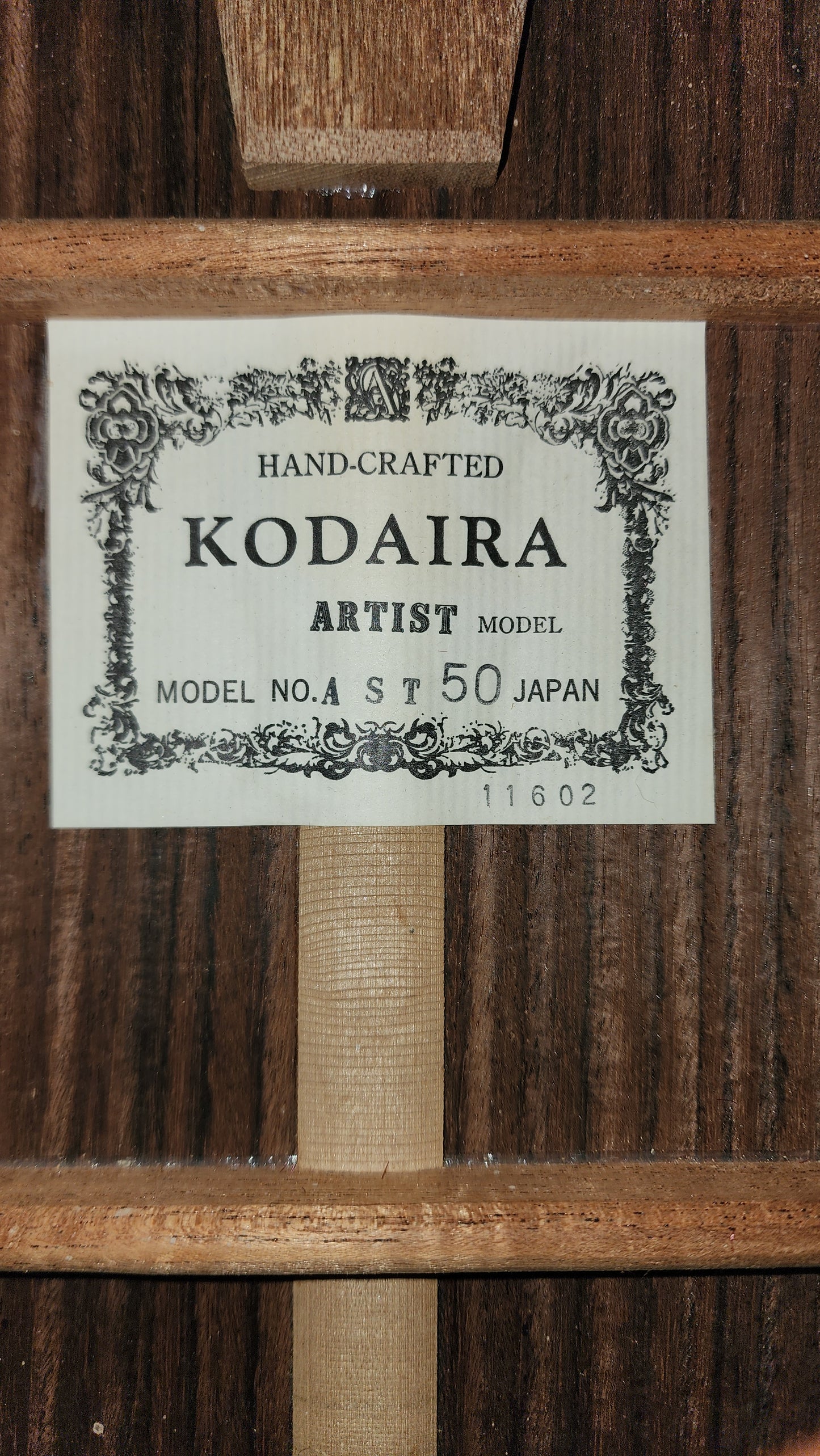
Kodaira Artist AST-50 Handmade Classical Guitar, Solid Cedar, IRW Japan 2000s
Kodaira Artist AST-50 Handmade Classical Guitar, Solid Cedar, IRW Japan 2000s
A very nice Kodaira Artist AST-50 . Hand-built in Japan in 2000s at the Asturias workshop.
More info and history on Asturias below the Specs.
The tone is very nice. Good resonance and balance of frequencies with lots of nuances.
It has good volume and sustain. There's ample amount of brightness and warmth in the low end.
Set up with D'Addario EJ46 (Hard Tension)
Condition
The guitar is in great considering it's at least 25 years old. There's no visible fretwear.
There is a very few minor signs of use that can only be seen up close. The visible blemishes or discolorations on the sides is not damage. It's the finish itself, which remains smooth and clean. In regular lighting, these features are less pronounced than they appear in the pictures. The origin of these characteristics is unknown. Those marks often appear on guitars with poly finish but they do not affect performance in any way. The white spots that you might see some of the photos are just reflections.
The guitar has been kept in a room with humidity set to 50% at 25 degrees (75F).
The neck is straight, action is medium low, comfortable to play.
Specs.
Top High Grade Solid Cedar
Bracing Fan
Back / Sides Indian Rosewood
Finish Polyurethane
Neck Mahogany, Natural Bone Nut
Fingerboard Rosewood
Bridge Rosewood, Natural Bone Saddle
String Length 650 mm
Nut width 52 mm
Action at 12 fret (1st): 2.75 mm
Action at 12 fret (6th): 3.25 mm
Comes with a hard case
Asturias Story and Kodaira's input into Japanese Luthier tradition.
Asturias guitars have gained widespread acclaim internationally for their exceptional tone and quality of craftsmanship. Produced at the same small workshop in Kurume, Japan, the team comprises approximately 10 highly skilled craftsmen, each capable of independently crafting a guitar. Since 1981, the workshop has been under the leadership of master luthier Wataru Tsuiji.
The Kurume workshop's guitar-making journey began in 1962 as Meiko Gakki co., under the ownership of the legendary Japanese luthier Masaru Matano, known as "the genius of sound." Matano earned this title before 1962 by enhancing the sound of numerous old violins, including renowned Stradivarius violins.
Initially, Meiko Gakki workshop focused on crafting classical guitars in limited numbers with a strong emphasis on quality. These guitars were initially sold under the Meiko Gakki label and signed by Matano. Around 1968, the labels were changed to "Masaru Matano Constructor de Guitarras," and by 1974-1975, another series of guitars with unique design labels was introduced, indicating production in Fukuoka, Japan.
Beyond this, during the same period of 1974-1975, Matano, along with a group of associates, produced La Esperanza guitars under the label "Ongaku Geijutsusha Co." Unlike Matano's guitars, La Esperanza guitars predominantly featured Spruce tops and Ramirez-style headstocks. While most of Matano's label guitars were not signed, many La Esperanza guitars had labels signed by their actual makers. The production of La Esperanza guitars continued until 1982, though in limited quantities.
Matano, like many luthiers, always worked with a team of highly skilled associates. Tatsuo Tanaka, his associate in the late 1960s, was the only one allowed to put his name on Meiko Gakki labels. The names of other associates, including Hiroumi Yamaguchi and Eichi Kodaira, remain unconfirmed, but they later joined the "New" Asturias team in 1980. In 1980, Rokkomann Co took over Matano's Kurume workshop, marking the birth of the "New" Asturias workshop. The details of this transition and Matano's disappearance in 1981 remain unclear.
Since 1981, Wataru Tsuji has led the Asturias workshop. In the same year, the "New" Asturias workshop implemented a serial number system on labels. The design, created in the mid-1970s, remained unchanged and was used on some of Matano's guitars.
Notably, associated luthiers such as Hiromi Yamaguchi, who established the "Cervantes" Concierto Guitarras brand in the early 1970s, and Eichi Kodaira, responsible for making AST models within the "New" Asturias team, played crucial roles. The narrative also highlights the continued success of Kodaira's workshop, operating with only three employees.
Guitars crafted by these Asturias-associated luthiers are highly regarded by international players for their quality, often considered the best in the mid-price range for classical concert guitars. It's essential to note that the pricing of guitars made by these artisans has consistently been moderate compared to similar-grade guitars by Masaru Kohno and other Japanese elite luthiers. Until 1980, Matano's top model, the Classe 1000, was priced at 100,000 yen, competing favorably with Masaru Kohno #20 from the same year. Until 1982, top Cervantes, La Esperanza, and Ecole models were also priced at 100,000 yen.
Couldn't load pickup availability
Out of stock
View full details