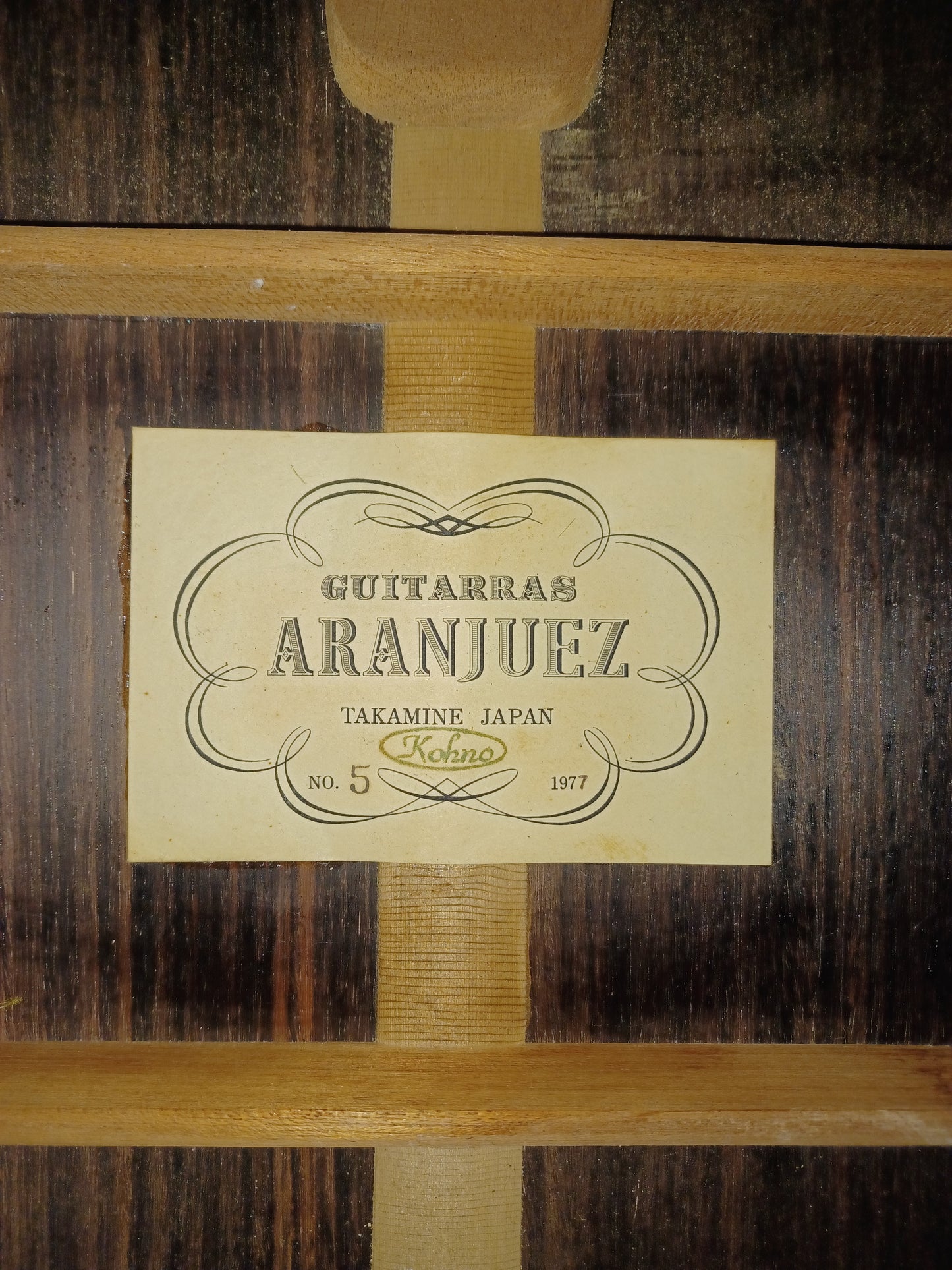
An incredible Takamine Aranjuez No 5 with Konho Top, Luthier built in Japan in 1977
The brand "Aranjuez" was created in early 70's during the cooperation of the well-known luthier Juan Orozco with the famous luthier Masaru Kohno and the Takamine Company. The guitars (without top) had been made by Takamine in Hirade's workshop. The top then had been chosen from Kohno's own stock of tonewoods and finished in his workshop. Players find that guitars with Kohno's top (Kohno stamp on the label) do sound somewhat similar to Kohno's guitars, but aren't as expensive as those made under Kohno or Sakurai brands. Kohno stopped his collaboration with Takamine in 1977.
The Aranjuez guitars from the following years don't have the Kohno top and the stamp on the label inside.
The condition of this guitar is unbelievable considering it's close to 50 years old.It' has only a few minor signs of use that can be seen when looking up close.The cloudiness that you can see on some photos are just reflections from the sun.
The guitar has been kept in a room with humidity set to 50% at 25 degrees (75F).The action is medium low, comfortable to play.
The guitar has a very rich tone. Good resonance and balance with lots of nuances.
It has impressive volume and sustain.
There's ample amount of brightness and warmth in the low end.
Specs.
Top: High grade Solid Red Cedar
Back and Sides: Indian Rosewood
Finish: Lacquer
Neck: Mahogany, Natural Bone Nut
Fingerboard: Ebony
Bridge: Rosewood, Natural Bone Saddle
Scale Length: 665 mm
Nut width 52.8 mm
Action at 12 fret (1st): 3.0 mm
Action at 12 fret (6th): 3.5 mm
Comes with a hard case
History of Japanese Classical Guitar Making
From the late 1960s Japanese luthiers produced guitars of exceptional quality. These skilled craftsmen typically ran small shops, employing a handful of master builders who were often trained in Spain or under Spanish master builders in Japan. During this period, bans on certain types of wood were not yet in place, allowing luthiers to source high-quality wood for their creations. Although these guitars are considered a bargain in today's market, finding top-quality Japanese classical guitars from this era can be challenging, and restrictions on exporting certain types of wood make them even more difficult to obtain. Similar guitars built with comparable materials today would cost significantly more due to the scarcity or complete bans on certain types of wood. Most of those talented luthiers from the 70s and 80s are now retired or have passed away.