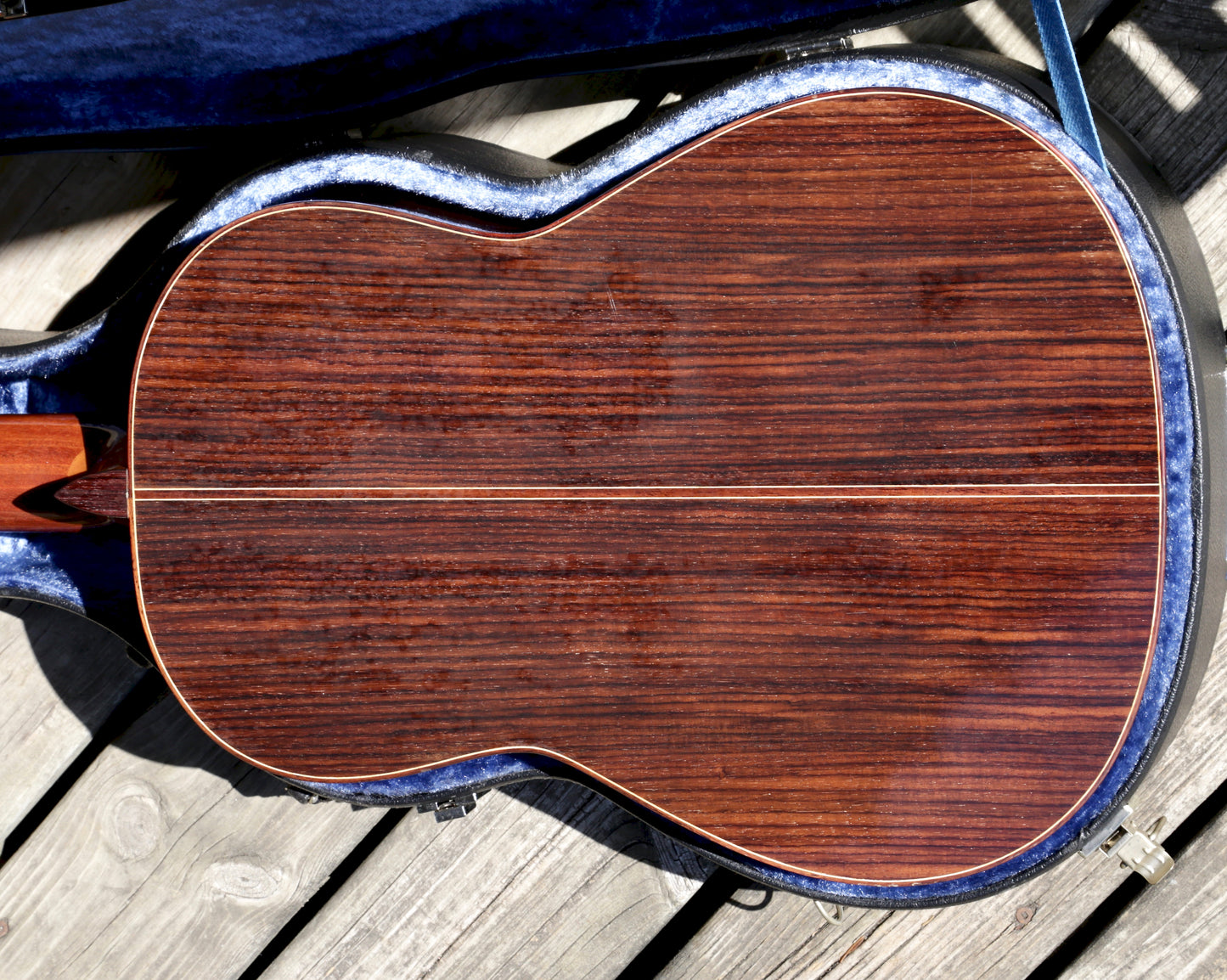
Yukinobu Chai No. 10 Handmade Classical Guitar Japan 2000s
Yukinobu Chai No. 10 Handmade Classical Guitar Japan 2000s
A beautiful Classical Guitar Handmade by Yukinobu Chai in 2000s, Model No 10
Ramirez design. High level of craftsmanship.
The Chai Family Guitar Workshop was founded in 1959 in Tokyo by Yukinobu Chai, one of Japan's leading luthiers, and is now succeeded by his son, Yukihiro Chai.
It appears that the workshop operates as a custom shop, not as a factory that produces a lot of guitars.
This particular guitar shows amazing craftsmanship and attention to detail.
Finest tone woods used to built it.
The tone of this guitar is balanced with good volume and good sustain.
Condition
The guitar is in used showroom condition. It has superficial marks of use in different places, such as dings and scuffs, but no major issues. The finish on the back, sides and bridge has some faint cloudiness, which is a common issue with aged guitars. Please refer to the pictures. Guitar players have different styles and features, so it might need to be set up according to your preferences. There's room on the saddle to lower it. The neck is straight and there is no visible fret wear.
Specs.
Top High Grade Solid Spruce
Bracing Fan
Back / Sides Indian Rosewood
Neck Mahogany, Natural Bone Nut
Fingerboard Rosewood
Bridge Rosewood, Natural Bone Saddle
String Length 650 mm
Nut width 52 mm
String Width: 42.5 mm
Body Thickness: 95 mm (3 6/8")
Action at 12 fret (1st): 3.60 mm
Action at 12 fret (6th): 3.75 mm
Comes with a hard case
Some history on Vintage Japanese Classical Guitars.
From the late 1960s Japanese luthiers produced guitars of exceptional quality. These skilled craftsmen typically ran small shops, employing a handful of master builders who were often trained in Spain or under Spanish master builders in Japan. During this period, bans on certain types of wood were not yet in place, allowing luthiers to source high-quality wood for their creations. Although these guitars are considered a bargain in today's market, finding top-quality Japanese classical guitars from this era can be challenging, and restrictions on exporting certain types of wood make them even more difficult to obtain. Similar guitars built with comparable materials today would cost significantly more due to the scarcity or complete bans on certain types of wood. Most of those talented luthiers from the 70s and 80s are now retired or have passed away.
Couldn't load pickup availability
Out of stock
View full details