
A Glossary of Steel-String and Classical Guitar Terms
Buying & Setup
The words that come up constantly in guitar shops, setup sheets and articles like ours — for both steel-string and classical guitars, defined plainly in one place.
Every hobby has its own vocabulary, and guitar has more of it than most — and a fair bit of that vocabulary splits between the two main acoustic families. This glossary pulls together the terms that come up most often across both steel-string and classical guitars (see our full nylon vs. steel-string comparison if you're deciding between them), the ones we use throughout our own guides, with plain definitions and, where it helps, a photo showing exactly what's being described. Terms shared by both types are marked; anything specific to one or the other is labelled clearly. Bookmark it and come back whenever a term trips you up.
◆
The body
- Top (soundboard)
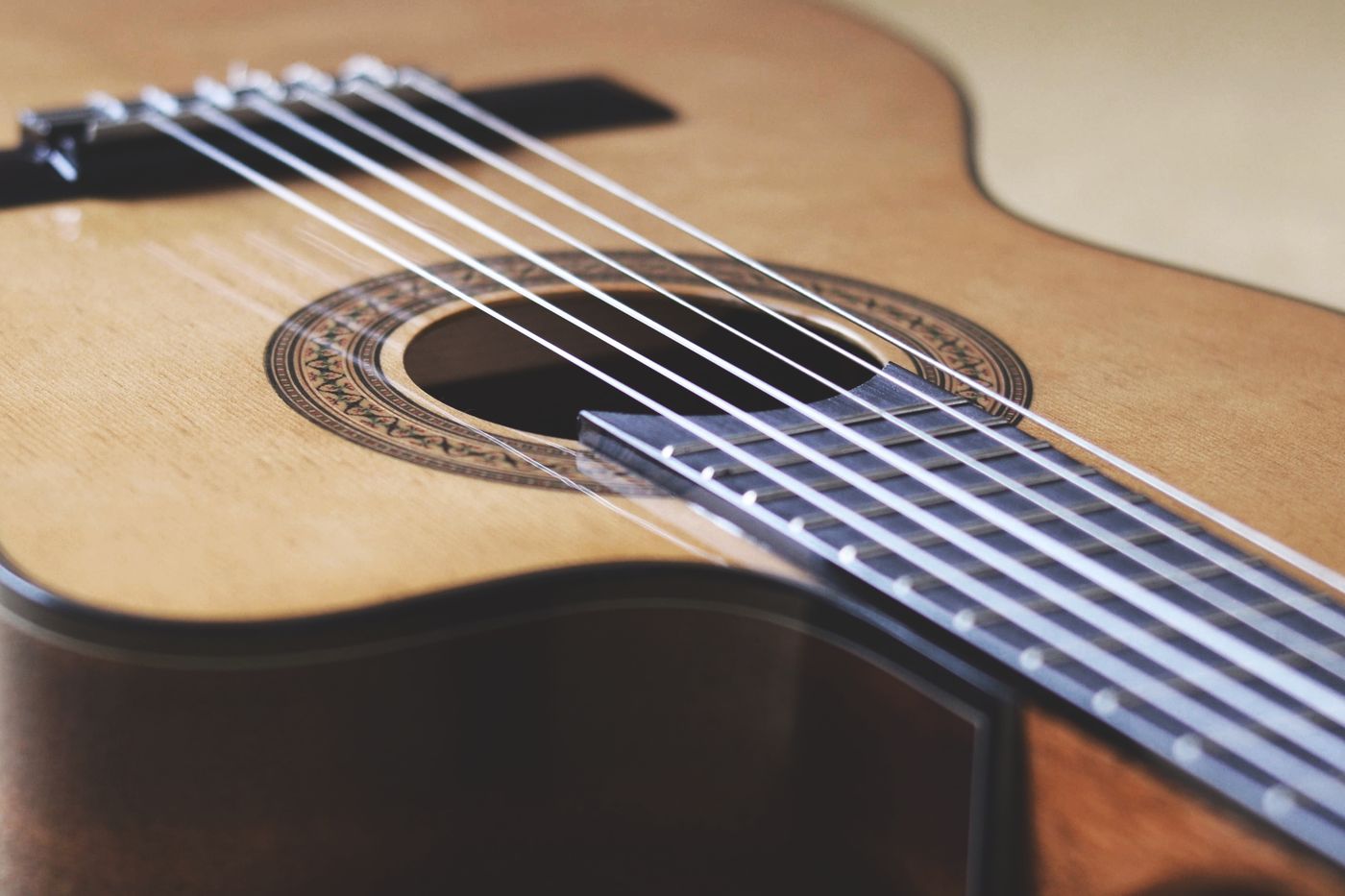
- The flat panel of wood facing you when you hold the guitar. It's the single biggest influence on tone, since it's the part that actually turns string vibration into sound. See our guide to tonewoods for how different top woods change the voice.
- Back and sides
- The rest of the body's wood shell. It acts as a resonating chamber, reflecting and colouring the sound the top produces.
- Soundhole
- The round opening in the top, positioned between the neck and the bridge, that lets the sound generated inside the body project outward.
- Rosette
- The decorative ring of inlay or mosaic surrounding the soundhole. Purely visual — it has no effect on tone — but it's often where a maker's craftsmanship and style are most visible at a glance.
- Bridge (shared term, different design)
- The wooden piece glued to the top, below the soundhole, that anchors the strings and transfers their vibration into the top. On a classical guitar, strings are tied directly onto the bridge; on a steel-string acoustic, they're held in place by bridge pins instead — see below.
- Tie block (classical)
- The raised section of the bridge with holes drilled through it, where each string is tied off. Our restringing guide walks through exactly how that knot is tied.
- Bridge pins (steel-string)
- Small pegs, usually plastic or bone, that hold each string's ball end in place inside the bridge on a steel-string acoustic. This is the steel-string equivalent of a classical guitar's tie block, doing the same job with a completely different mechanism.
- Saddle
- A thin strip, usually of bone or a synthetic substitute, set into the bridge just in front of the tie block. The strings pass over it on their way to the tuning pegs, and its height is one of the main things that sets the guitar's action.
- Bracing
- The pattern of thin wooden struts glued to the underside of the top (and sometimes the back), invisible from outside, that reinforces the wood against the pull of the strings while still allowing it to vibrate freely. Bracing pattern has a real, audible effect on tone.
- Body shape (Dreadnought, OM, Parlor, Jumbo) (steel-string)
- Steel-string acoustics come in a range of standardised body sizes and shapes, each with its own tonal tendency — a Dreadnought is large with a strong, bass-forward voice; an OM (Orchestra Model) is smaller and better balanced for fingerstyle; a Parlor is small and light, favouring the mids; a Jumbo is large and rounded, built for volume and low end. Classical guitars, by contrast, are far more standardised in size and shape across the whole instrument family.
- Cutaway (mainly steel-string)
- A curved notch carved into the body where it meets the neck, giving the fretting hand access to the highest frets. Common on steel-string acoustics, especially those with electronics; traditional classical guitars rarely have one.
- Pickguard (scratchplate) (steel-string)
- A thin protective plate fitted to the top below the soundhole, guarding the finish against pick strikes. Common on steel-string acoustics played with a plectrum; rare on classical guitars, which are played fingerstyle.
◆
The neck and headstock

- Nut (shared term)
- The small strip, usually bone or a synthetic material, at the top of the fretboard where it meets the headstock. Each string passes through a shallow groove cut into it, and its height affects the action at the low end of the neck.
- Fretboard (fingerboard)
- The thin strip of hard wood, often ebony or rosewood, glued to the front of the neck, where the frets are set and where the fretting hand presses the strings.
- Frets
- The thin metal strips embedded across the fretboard at set intervals. Pressing a string down just behind a fret shortens its vibrating length to produce a specific note.
- Headstock (shared term, different shape)
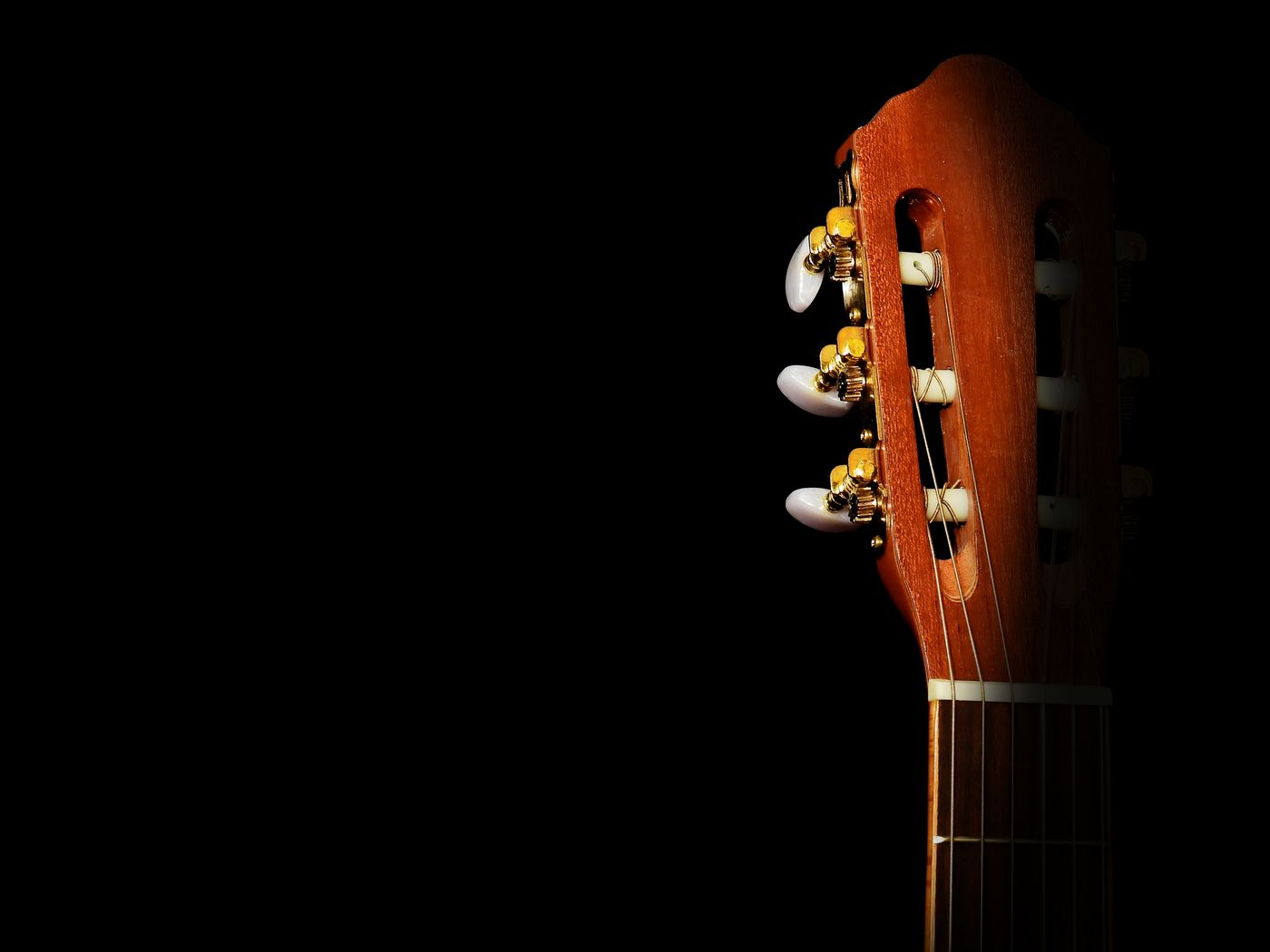
- The section at the top of the neck holding the tuning machines. Classical guitars almost always use an open, slotted headstock, where the strings pass through visible slots; steel-string acoustics typically use a solid, paddle-shaped headstock with strings anchored through the back.
- Tuning machines (tuning pegs, machine heads)
- The geared mechanisms that adjust string tension to bring each string to pitch. On a classical guitar, each one turns a small roller with a hole through it, where the string is threaded and secured.
- Scale length
- The vibrating length of the string, measured from the nut to the saddle. It's one of the biggest factors in how a guitar feels to play — see our full guide to scale lengths for how it affects tension and stretch.
◆
Setup and playability

- Action
- The height of the strings above the frets. Lower action makes a guitar easier and faster to play but is more prone to buzzing; higher action gives cleaner sustain but takes more finger strength. It's adjusted mainly through the height of the nut and saddle.
- Setup
- The general term for adjusting a guitar's action, intonation and overall playability after it leaves the factory. New guitars very often benefit from a proper setup before their action feels right.
- Intonation
- How accurately a guitar stays in tune with itself as you move up the neck. A guitar with poor intonation might be perfectly in tune on the open strings but noticeably sharp or flat higher up the fretboard.
- Tension (string tension)
- How tightly a set of strings pulls against the neck, usually labelled low, normal or high. It's the single biggest factor in how strings feel under the fingers — our guide to string types covers this alongside material choice.
- Truss rod (mainly steel-string)
- A steel reinforcing bar running through some necks, adjustable to correct bowing. Common on steel-string guitars; far less common on classical guitars, which run at much lower string tension and often don't need one.
◆
Wood and construction
- Tonewood
- Any wood species chosen specifically for its acoustic properties in an instrument, rather than just its appearance or cost. See our full tonewoods guide for a tour through the most common and most exotic options.
- Solid wood
- A top, back or side made from a single continuous piece (or book-matched pair) of one species of wood, as opposed to layered laminate. Generally produces a fuller, more resonant tone that improves with age.
- Laminate
- A top, back or side built like plywood, from several thin layers of wood glued together. More resistant to cracking and humidity swings than solid wood, at some cost to tonal depth. Our solid vs. laminate guide covers the trade-off in full.
- Luthier
- A craftsperson who builds or repairs stringed instruments by hand. The term applies to guitar makers, violin makers and similar instrument builders alike.
- Golpeador
- A thin tap plate fitted to a flamenco guitar's top, protecting the wood from the percussive tapping (golpe) that's part of flamenco technique. Classical guitars don't have one. See our nylon vs. steel-string comparison for more on how guitar types differ.
◆
New terms tend to make sense quickly once you've actually seen and handled the part they describe — which is really the best way to use a glossary like this one: not as something to memorise up front, but as a quick reference to check whenever an unfamiliar word gets in the way of understanding the rest.
A plain-English glossary of classical guitar parts and terms, with photos, for anyone new to the instrument.